
The Push to Reimagine Artists Bluff
By Lily Hartman
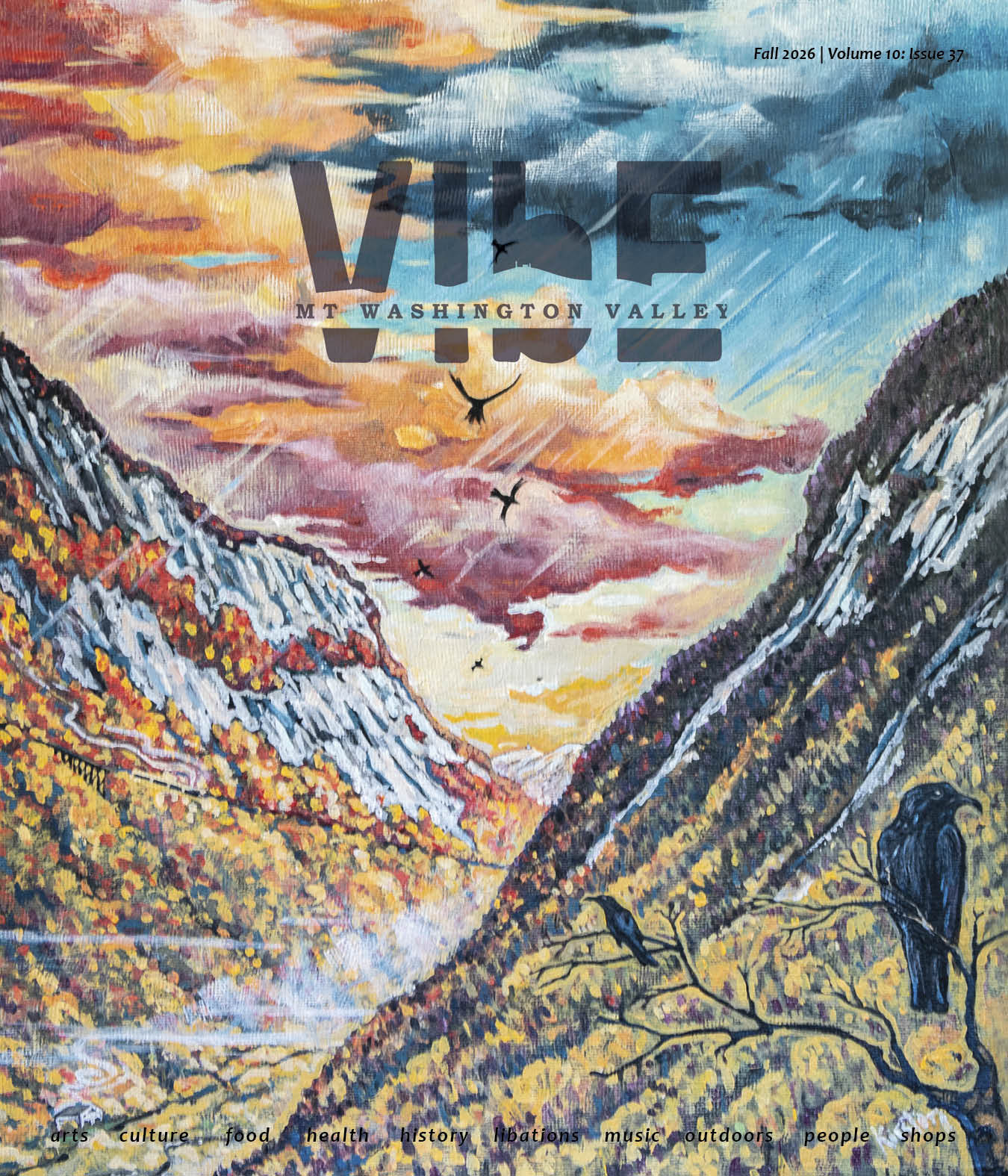
(opening image captured by www.WhiteMountainImages.com and is available for print)
T here’s nowhere like New England in the fall, especially the White Mountains. Take one drive down the Kancamagus Highway, located between Lincoln and Conway, and you’ll understand why. The changing colors are beyond vibrant: yellow, orange, and a red so deep it often looks hot pink. It’s as if a painter took buckets of paint and flung them, Pollock style, all over the trees.
This scenic drive alone is a major tourist attraction, as are many hiking trails. Artists Bluff, a 1.5-mile loop trail in Franconia Notch State Park with stunning views of Echo Lake, has become one of the best spots to view fall foliage. It didn’t take long for word of this hike to spread on social media.
In 2024, #artistsbluff had more than 1,000 tagged posts on Instagram, according to WMUR, a primary ABC-affiliated television station serving New Hampshire. By October 2025, NHPR, the state’s public radio news service, reported that over 19,000 images and reels of the hike had been posted on Instagram.
Some visitors may not realize that although this hike is relatively easy, with only 427 feet of elevation gain, it has a steeper section near the top, so it may not be accessible to every visitor, as social media makes it seem.
On a Saturday in mid-October 2024, Robert White, project manager for the World Trails Network (WTN), was heading south down I-93 when he noticed approximately 1,000 hikers gathered at the summit of Artists Bluff. He couldn’t believe his eyes.

Visitors crowd the Artists Bluff area during a recent foliage season. Social media has made this a common sight on many White Mountain trails not built to handle so much foot traffic.
The crowd was partly the result of the Cannon Mountain Aerial Tramway shutting down, leaving thousands of tourists looking for something to do in the area. This spot became an immediate Instagram sensation. “Oh boy,” says White. “That’s a place in trouble.”
On a wintry afternoon in December 2024, White ventured to the Artists Bluff Trail to explore the relationship between the distance to the summit and the total elevation to get there. It was steep in some places, perhaps too steep for many of the tourists who come here. So, he decided to bushwhack sideways back across the mountain, all the way to the parking lot, while maintaining roughly a 5 percent grade. He hung some flags from the trees to try and follow the line from the top of Artists Bluff to the parking lot at Peabody Slopes. He realized it might be possible to build a handicap-accessible trail up there.
White and his friend Jace, a great supporter of the study, brought a proposal to the Professional Trailbuilders Association (PTBA) and American Trails through the WTN with their idea. These organizations supported this project and thought that a broader consideration of trail options might be something the state would appreciate, as it would bring more opportunities to Artists Bluff.
White moved forward with his vision by putting together a working paper for the New Hampshire Department of Natural and Cultural Resources (DNCR). His goal was to show the director of the state parks and the senior planning staff that reconstructing the trail system could provide a safer, more comfortable, and more worthwhile experience. Many state park officials were interested in the project and agreed that it may be possible to pursue.
From June 8 to 11, 2026, White hosted a professional course with Jace, trail builder Peter Jensen, and trail builder Erin Amadon. About 15 participants attended the four-day course, arriving from areas such as California, Arizona, the White Mountain National Forest, and other parts of the Northeast. If the Artists Bluff renovations get the green light, funds from the course will contribute to the work to be done. Tuition for the course was paid by most participants through scholarships from the Professional Trailbuilders Association. American Trails also provided marketing and communication support.
The course started with sessions to discuss sustainability and accessibility on trails, current trail conditions, and the impacts of increased tourism on trails. Then, the group headed out to the field to get the lay of the land and share their initial thoughts. Splitting into three groups, each played a different role.
The first group looked at the Artists Bluff Trail to see how it can be reconstructed. Artie Hidalgo, a trail builder for 17 years and the co-founder of the Jolly Rovers Trail Crew, an all-volunteer trail-building group, was part of this group at the course. “The trail is in really bad shape—there are a lot of areas where you can make major improvements really quickly,” says Hidalgo.
The second group was given the entire mountainside to create a comprehensive alignment beginning at the parking area. Rather than looping around the edge on the existing trail, they decided to explore other parts of the mountain and found some amazing spots to thread the trail through these massive, ravine-like boulders. This would thread the trail around boulders covered in ferns. It is a magical spot that brings visitors to the viewing area.
“We have a site of great American historical, environmental, and cultural significance, and it’s really about setting up the whole area for a successful experience for people to understand that it’s more than just running up, taking a picture of the view [for social media], and running down,” says White.
The third group started at the bottom and mapped out an accessible trail along the mountain’s contours. Although they found a route from both ends, they were about 30 feet off. By the next day, the group had sharpened their pencils, laid out flag lines on the field, taken measurements, and tried to gauge what building different trail scenarios would involve.
The Artists Bluff Trail is built as a fall line trail, so it runs directly up the mountain. This makes it prone to erosion; its steep terrain also makes it poorly suited to inexperienced hikers, meaning it’s not well-suited for inexperienced hikers. Plus, its narrowness forces people off trail when crowded. According to Hidalgo, some sections range from 18 to 20 inches wide.
“Toward the top, there was a lot of opportunity for widening the treadway because it was obvious that people were bypassing sections of the trail,” says Hidalgo. By the end of the course, people from state parks watched the group present their findings during the fieldwork. According to White, many people from the Bureau of Trails (DNCR) took an interest in the project—and especially loved the idea of an accessible trail.
When White visited the trail shortly after the course, there was a solid line of people to the top where the trail goes up above the beach. And it wasn’t even close to being fall. “The first time I hiked Artists Bluff was right after hiking Mount Osceola. I wanted to squeeze in one more quick hike before the day ended. Since the Artists Bluff Trail is short, I didn’t think it would take too long to complete, but I was wrong.”
It was during a weekend afternoon in late summer, and I lucked out finding a parking spot. Right when I got on the trail, hikers were passing me every second—wearing cameras around their necks and jeans that aren’t meant for hiking, as well as going off trail, leaving trash on the mountain, and ignoring any sort of trail etiquette.
For this project to take action, White says that we need to convey “… that it’s more than a single trail; it needs to be a network.” With the number of people going up and down Artists Bluff, especially in the summer and fall, it makes more sense to create a loop rather than keep the single-trail location. Otherwise, traffic congestion and delays will continue to pull hikers out of the wilderness experience.

In 2024, visitors crowded the Artists Bluff area during foliage season. Now, in 2026, this has become a regular occurrence. Courtesy photo.
In addition to receiving approval, funds are needed to move forward with work on Artists Bluff. Funding could come from recreational trail grants, the town of Franconia, state parks, and the Northern Border Regional Commission. Additionally, U.S. Rep. Maggie Goodlander would like to identify a major funding package for the potential project on the Artists Bluff Trail.
For the project to move forward, White believes it will require cooperation among groups such as the New Hampshire Arts Council, state park officials, the Division of Economic Development, the New Hampshire Historical Society, and the town of Franconia. Improving the hiking experience, he says, could attract more visitors and create greater economic opportunities for the region.
White believes that by investing in creative, innovative ways to sustainably repair and improve trails, the state can see returns that far outweigh the initial investment.

A conceptual sketch shows one of six proposed rest areas along the Artists Bluff Trail. In addition to providing places for visitors to stop and rest, the widened sections would serve as passing and turning points for machinery during trail construction. Illustration courtesy of Mountain Steward.
White predicts that from Artists Bluff alone, the region might see an income increase of about $1 million during foliage season.
To some, Artists Bluff may seem like just another short hike in the White Mountains, but its appeal reaches far beyond the summit view. For generations, artists have come to capture Echo Lake glimmering between the mountains, the dark spruce and fir trees lining its shores, and Franconia Ridge and Cannon Mountain rising in the distance. It is a landscape worth experiencing—and protecting for those who come next.

Trail professionals from across the country gathered in Franconia Notch in June for a four-day course focused on sustainable trail-building techniques. The training brought together roughly 15 participants from the White Mountains, the Northeast, Arizona, and California.
Until the Artists Bluff project becomes a reality, New Hampshire State Parks has taken steps to reduce congestion during foliage season. As shown on the map below, hikers now follow a one-way route to improve visitor flow and safety while reducing conflicts along the narrow trail. Seasonal staff assist with parking, trail use, and traffic control, while more trash receptacles and portable toilets help accommodate visitors. For additional information about the Artists Bluff traffic pattern and visitor services, visit www.NHStateParks.org.

This link will bring you to any updates made from the State of NH